Will AI take my staff's jobs? What the numbers actually say
AI will change most jobs, but the evidence points to changed tasks, not empty offices. Here is what the research says, and what a business owner should do about it.
Every business owner has heard it by now: AI is coming for jobs. Some say it with excitement, others with fear. Both usually skip the part that matters, which is what the research actually found.
The short answer is this: AI is very good at some tasks and poor at others. Most jobs are a mix of both. So for most businesses, the question is not "who do we replace?" but "which parts of each job should a machine do?"
What the biggest study found
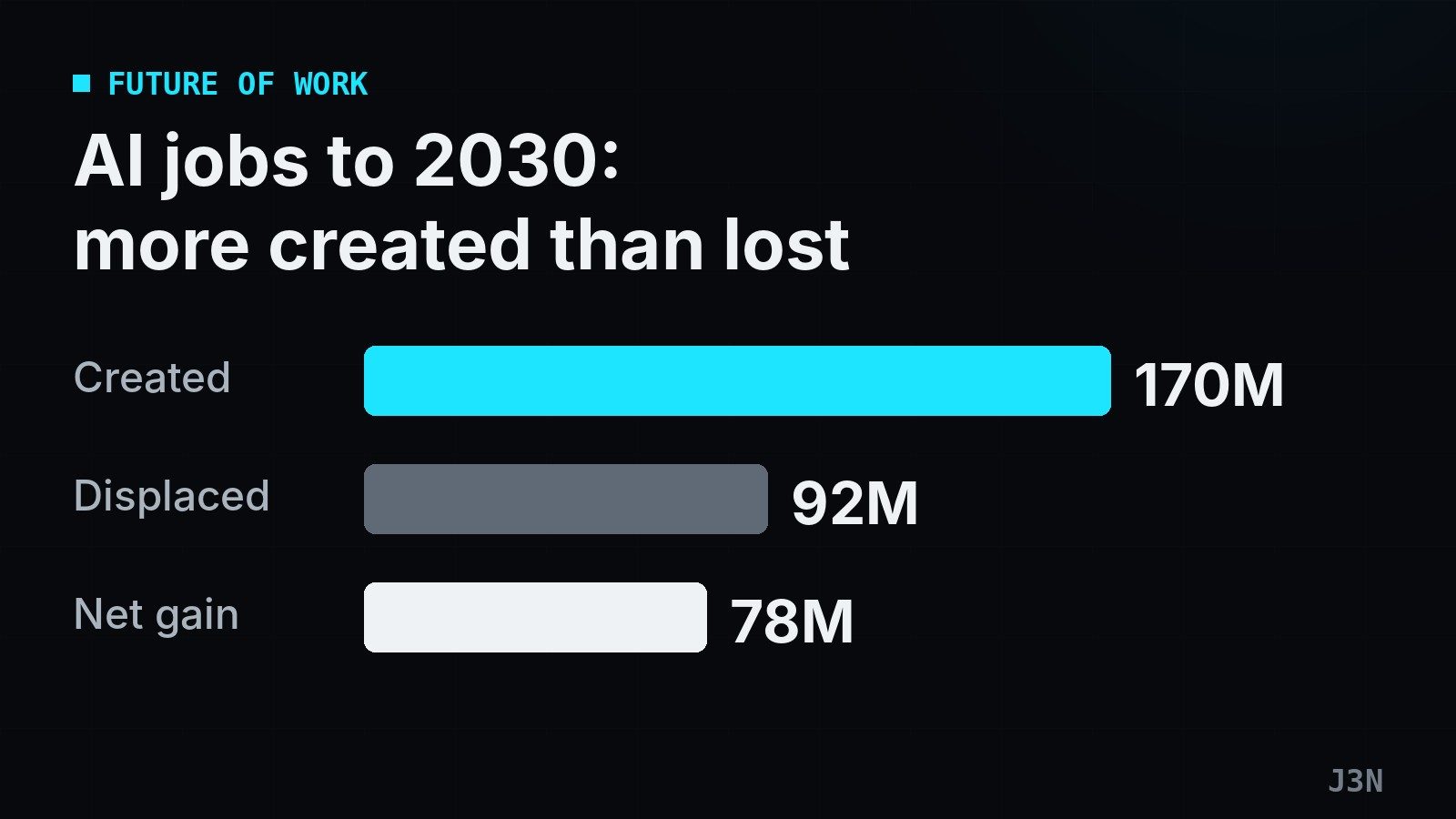
The World Economic Forum's Future of Jobs Report 2025 surveyed more than 1,000 employers in 55 economies, covering over 14 million workers. Its estimate for the five years to 2030:
- about 170 million new roles created,
- about 92 million roles displaced,
- a net gain of about 78 million jobs.
That is a lot of movement. Roughly one in five jobs is expected to change in a meaningful way. But the overall direction is more work, not less. The jobs growing fastest include data, AI and technology roles, but also care, education and other work that needs people.
…creating both unprecedented opportunities and profound risks.
Till Leopold, World Economic Forum
It is about tasks, not whole jobs
McKinsey looked at this from a different angle: hours of work rather than job titles. In its study of the US economy, it estimated that automation could take over about 21.5% of hours worked by 2030 without generative AI. With generative AI, that rises to about 29.5%.
Notice what that means. Even in one of the most automated economies in the world, about 70% of working hours stay with people. And the hours that move are mostly the repetitive ones: typing up records, copying figures between systems, answering the same question for the tenth time, preparing routine reports.
Physical work is much harder to automate. McKinsey expected only a small change for farm work. That matters in Kenya, where so much of the economy is hands-on: building, fabrication, transport, farming, retail.
What this means for a Kenyan business
Kenya's micro, small and medium businesses employ about 14.9 million people and produce roughly 28.5% of GDP, according to the Kenya National Bureau of Statistics. Most of these businesses are not about to buy robots.
What they can do is take the boring work off their people. Some honest examples:
- Paperwork: invoices, receipts, delivery notes and quotations created from records already in the system, not retyped.
- Follow-ups: reminders for unpaid invoices, upcoming bookings or expiring documents sent on time, without someone having to remember.
- Questions: common customer questions on WhatsApp answered quickly, with a person stepping in for anything unusual.
- Reports: the daily or weekly summary put together from live data instead of a late night with a calculator.
None of these remove a job. They remove the parts of a job that nobody enjoys and that cause the most mistakes.
What AI should not decide
There are tasks AI should support but not own:
- pricing a custom order or negotiating with a customer,
- approving payments or refunds,
- anything that needs local knowledge, trust or judgement,
- anything where a wrong answer is expensive.
A good rule: let AI prepare, and let a person decide.
Where to start
1. List the repeated tasks. Ask each staff member what they do every day that feels like copying, chasing or retyping.
2. Pick one with clear rules. For example, "send a reminder three days before an invoice is due".
3. Automate that one task well. Measure the time saved for a month.
4. Move the saved time to customers, sales or quality. That is where the real return is.
The businesses that do well over the next five years will not be the ones that replace their staff. They will be the ones whose staff spend their time on work that machines cannot do.
From our work: in the business systems we build in Kenya, the first things to be automated have never been people. They were the receipt book, the retyped price list and the month-end report.
Sources
- World Economic Forum, Future of Jobs Report 2025
- World Economic Forum, press release with the Till Leopold quote (7 January 2025)
- McKinsey Global Institute, Generative AI and the future of work in America
- Kenya National Bureau of Statistics, MSME Survey