Almost every business now uses AI. Very few get much from it yet.
Business use of AI jumped in a single year, but most companies report small savings. Why the gap exists, and how to start with AI in a way that actually pays.
If you feel that everyone is using AI except you, you are partly right. Business use of AI has grown very fast. But there is a second part of the story that gets less attention: most of those businesses are not getting much out of it yet.
Both facts matter if you are deciding what to do next.
The adoption numbers
Stanford University's AI Index Report 2025 is one of the most respected yearly summaries of the field. It found that:
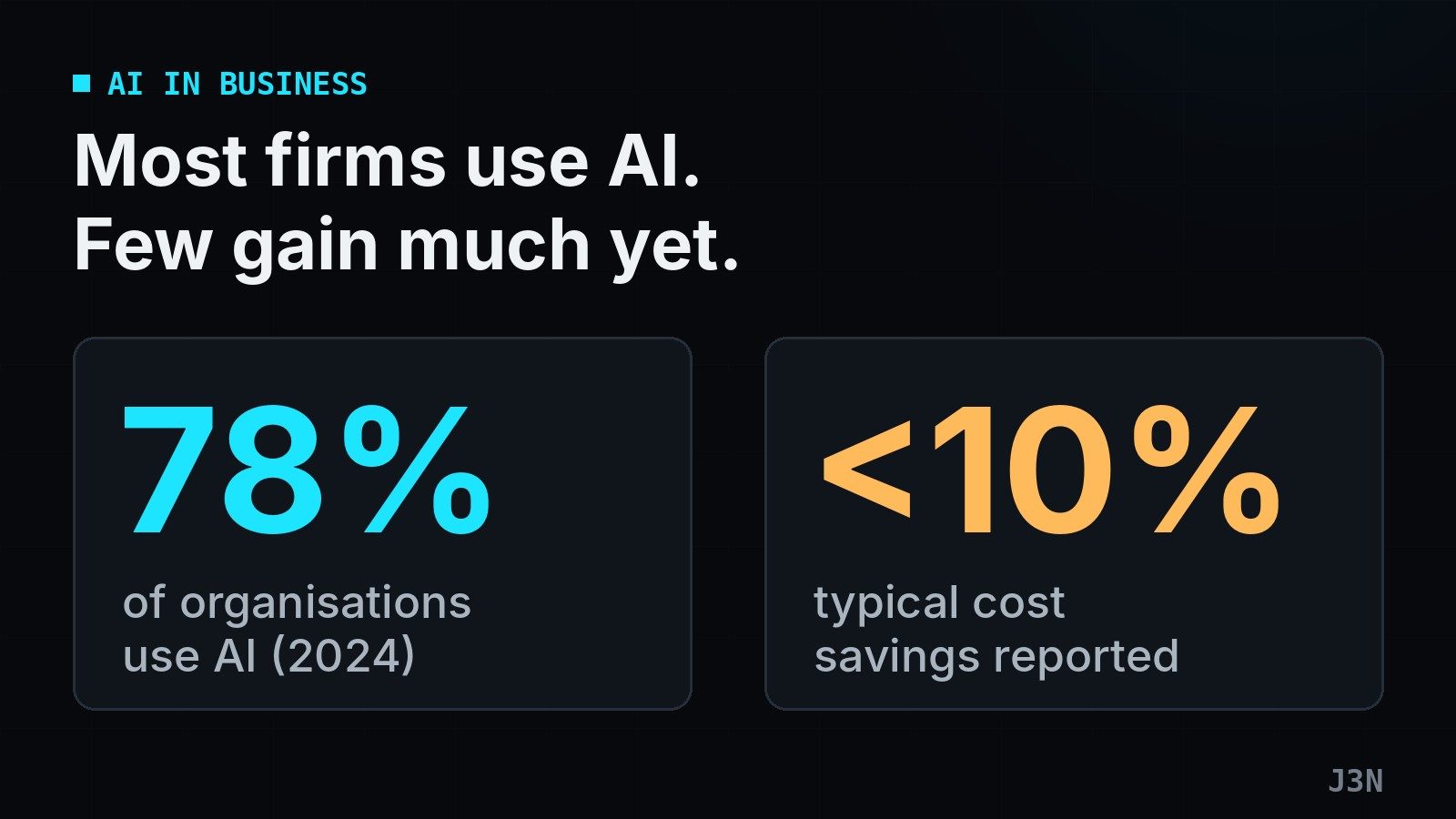
- 78% of organisations reported using AI in 2024, up from 55% the year before,
- 71% were using generative AI (tools like chat assistants and writing tools), up from about a third,
- the cost of using advanced AI models has dropped sharply, making it affordable for small businesses too.
So the tools are now cheap and widely used.
The value numbers
Here is the less exciting part. Among companies that reported savings from AI, most saw cost savings of less than 10%, and most revenue gains were under 5%. Very few senior leaders described their AI projects as mature.
Real business impact lags behind adoption.
VentureBeat, on the AI Index 2025
Why the gap?
From what we see in practice, the reasons are usually the same:
- AI added on top, not built in. Staff copy text into a chat tool, then copy the answer back. It helps a little, but the process stays the same.
- No clean data. AI cannot summarise sales that are spread across notebooks, WhatsApp chats and three spreadsheets.
- No clear job for it. "Use AI" is not a task. "Draft a reply to every new enquiry within five minutes" is.
- No checking. AI can be confidently wrong. Without someone reviewing important outputs, mistakes slip through and trust drops.
How to start in a way that pays
1. Get your records in order first. AI is only as useful as the information it can reach. A business with its sales, stock, customers and payments in one system can do far more with AI than one that cannot answer basic questions about itself.
2. Pick one narrow, repeated task. Good first candidates:
- reading supplier invoices or delivery notes and filling in the details,
- drafting quotations or replies from a set of standard answers,
- sorting incoming messages by type and urgency,
- writing a plain-language summary of yesterday's numbers.
3. Keep a person in the loop. Let AI prepare, and let a person approve, especially anything involving money, prices or customers.
4. Measure before and after. Time per task, errors per week, response time. If the numbers do not move in a month, change the approach.
5. Then connect it. The biggest gains come when AI is part of the system itself, not a separate tab. For example, an invoice photo goes in, the details are read, checked against the supplier and order, and only flagged to a person if something does not match.
The real opportunity
The good news in these numbers is for smaller businesses. Large companies are struggling to fit AI into old, complicated processes. A small business with simple, well-recorded processes can often move faster.
The businesses that win with AI will not be the ones that tried the most tools. They will be the ones that picked the right tasks, built them into how they work, and kept a person in charge of the decisions.
From our work: where our systems use AI, it drafts and summarises: replies to customers, a plain-language summary of the day's sales. Prices, refunds and payments stay with a person.
Sources
- Stanford HAI, AI Index Report 2025 (adoption, cost-savings and maturity figures)
- VentureBeat, Stanford's AI Index: 5 critical insights (source of the quote)