eTIMS: why manual invoicing is now costing Kenyan businesses money
Since 2024, expenses without an eTIMS invoice cannot be claimed against tax, and KRA now checks returns against eTIMS data. What changed, and how to stay on the right side of it.
For years, many Kenyan businesses treated invoices as paperwork: a receipt book, a Word template, a WhatsApp photo. That no longer works. Since the Finance Act 2023, the way you invoice, and the invoices you accept from suppliers, directly affects how much tax you pay.
This article explains the rules in plain terms. It is general information, not tax advice, so confirm your own position with your accountant.
What eTIMS is
eTIMS is the Kenya Revenue Authority's electronic Tax Invoice Management System. Instead of printing invoices from your own system or a book, invoices are created through eTIMS (or a system connected to it) and sent to KRA as they are issued.
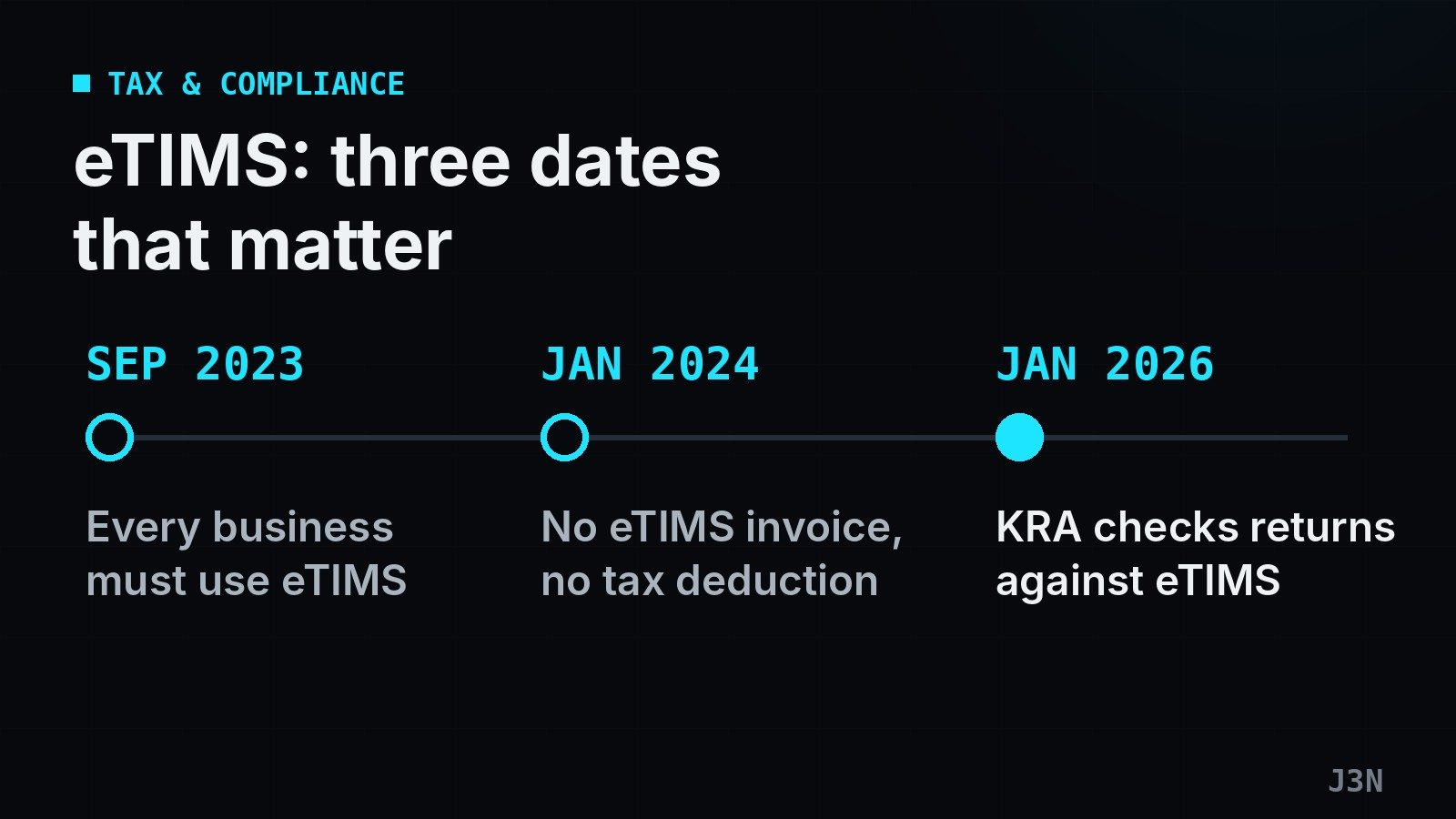
The three dates that matter
1 September 2023. All businesses had to start issuing invoices through eTIMS, whether or not they are registered for VAT. This was the big change: it is not only for large or VAT-registered companies.
1 January 2024. Business expenses that are not supported by a valid eTIMS (or TIMS) invoice can no longer be deducted for income tax. There are some exemptions in the law, such as salaries, imports and interest, but for most everyday purchases the rule applies.
…business expenditure not supported by an eTIMS generated tax invoice shall not be deductible…
Kenya Revenue Authority public notice
1 January 2026. KRA validates income and expenses declared in tax returns against eTIMS data, withholding tax records and customs records. In practice, the figures in your return must match what eTIMS already knows.
Why this costs money if you ignore it
Imagine you spend KSh 500,000 in a year on materials, transport and repairs, but half of your suppliers did not give you eTIMS invoices. Those expenses may not count. Your taxable profit goes up, and so does your tax, even though you really spent the money.
Audit firm KPMG has warned that such expenses can now be disallowed automatically, with penalties and interest possible on top.
The risk runs both ways:
- As a buyer: every supplier who does not give you an eTIMS invoice may be making your tax bill higher.
- As a seller: if you do not issue eTIMS invoices, your business customers cannot claim what they paid you. Many will start to prefer suppliers who can.
Where manual processes break
- Invoices typed in a template, then entered into eTIMS later, or forgotten.
- Supplier invoices kept as photos, with no check that they are valid eTIMS invoices.
- Sales recorded in one place, invoices in another, so totals never quite match.
- Month-end becomes a hunt for missing documents.
How automation helps
A business system connected to eTIMS removes most of this work:
1. Invoice once. When a sale is recorded, the invoice is created and sent to KRA in the same step.
2. Check supplier invoices. Purchases are recorded against the supplier's eTIMS invoice number, so missing ones are flagged before you pay, not after the tax return.
3. Keep records matched. Sales, purchases and payments sit in one place, so the totals you declare match what KRA sees.
4. Credit notes, not edits. Corrections are made the proper way, leaving a clear trail.
A simple checklist for business owners
- Are all your invoices going through eTIMS today?
- Do your main suppliers give you eTIMS invoices? Have you asked?
- Can you list last month's purchases that had no eTIMS invoice?
- Do your sales records match what was invoiced through eTIMS?
- Does your accountant see the same numbers you do?
If any answer is "no" or "not sure", that is where to start.
From our work: in the systems we build, every invoice shows its KRA eTIMS status next to its payments, so an owner can see at a glance which sales still need attention.
Sources
- Kenya Revenue Authority, On-boarding of non-VAT taxpayers on eTIMS
- Kenya Revenue Authority, Public notice: complying with electronic tax invoicing
- Bowmans, eTIMS and the Finance Act 2023
- KPMG Kenya, eTIMS: enforcement and income tax validation