Cash, M-Pesa, bank: why most businesses don't know their real balance
Money arrives through three channels but is often tracked in one notebook. Where it leaks, and a simple daily routine to always know what you really have.
Ask most business owners how much money the business has right now, and you will get a pause. There is cash in the drawer, money on the till number, something in the bank, and a list of customers who "will pay on Friday". Each one is tracked differently, or not at all.
That gap between what you think you have and what you really have is where profit quietly disappears.
Mobile money is now the main road for business money
M-Pesa is not a side channel any more. In the year to March 2026 it processed about 46.4 billion transactions worth roughly KSh 41.7 trillion. For most businesses, it is now where the money actually arrives.
Fewer payments, bigger amounts
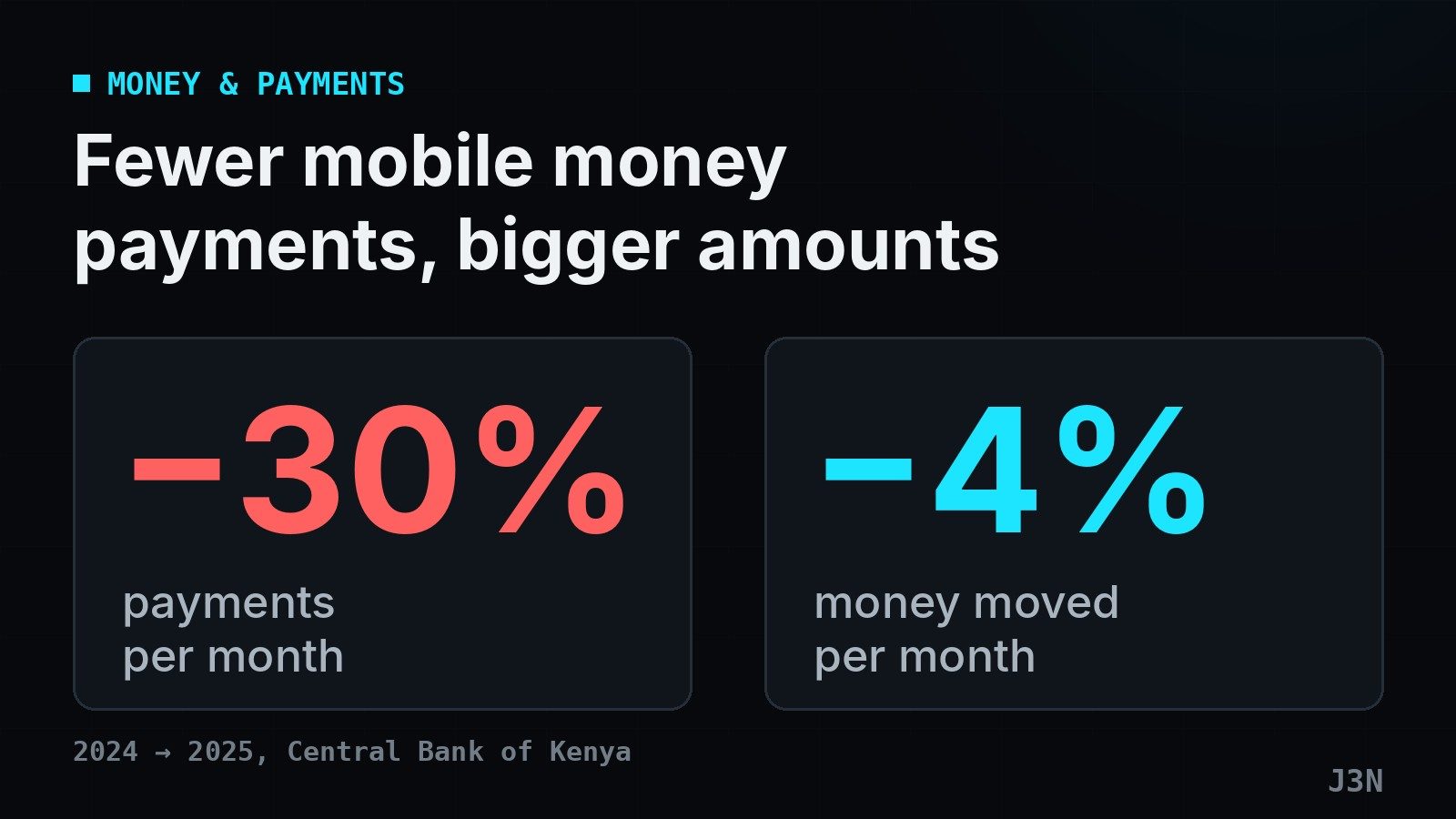
The CBK's Bank Supervision Annual Report 2025 shows an interesting shift. Monthly mobile money transactions fell about 30% between 2024 and 2025, from roughly 309 million to 218 million. But the value fell only about 4%, from about KSh 753 billion to KSh 722 billion a month.
In other words, people are making fewer payments, but each one is bigger. For a business, that changes the risk. Missing one small payment was annoying. Missing one large payment is a real loss.
Where the money leaks
- Payments that are never matched. A customer pays KSh 45,000 by M-Pesa, but nobody links the code to an invoice. Weeks later, the customer is chased for money they already paid, or the payment is forgotten entirely.
- Several till or paybill numbers. Money lands in different places and nobody adds them up together.
- Cash that is not counted daily. If the drawer is only counted "when needed", shortages cannot be traced to a day or a person.
- Refunds and reversals. Money goes back out, but the records still show it as received.
- Personal and business money mixed. Owners pay business costs from personal lines and forget to record them, so profit looks better than it is.
What a clear picture looks like
You should be able to see, at any moment:
1. how much is in each account (cash, each M-Pesa number, each bank),
2. which invoices are paid, partly paid or unpaid,
3. what came in and went out today, and why.
None of this needs complicated software. It needs every payment recorded once, against the thing it pays for.
A 10-minute routine any owner can start tomorrow
Every morning:
- Check yesterday's M-Pesa and bank statements.
- Match each payment code to a customer invoice. Anything unmatched goes on a list to call about.
Every evening:
- Count the cash. Compare it with the day's cash sales and expenses.
- Write down any difference, however small, with a reason.
Every week:
- Look at the list of unpaid invoices. Call the oldest ones first.
- Check that the balance in each account matches your records.
Done by hand, this takes discipline. A business system makes it close to automatic: payments are recorded with their M-Pesa code or bank reference, invoices update themselves, and one screen shows the balance of every account.
The goal is simple. When someone asks "how much do we have?", the answer should take seconds, and it should be right.
From our work: in one shop we built a system for, customers pay into a paybill and staff record each payment by hand with its reference code. The daily match against the statement is what keeps the balance honest.
Sources
- Central Bank of Kenya, Bank Supervision Annual Report 2025 (mobile money figures, Table 8)
- Central Bank of Kenya, announcement of the 2025 report
- TechTrends Kenya, M-Pesa transaction figures for the year to March 2026