What an Operations Management System actually does
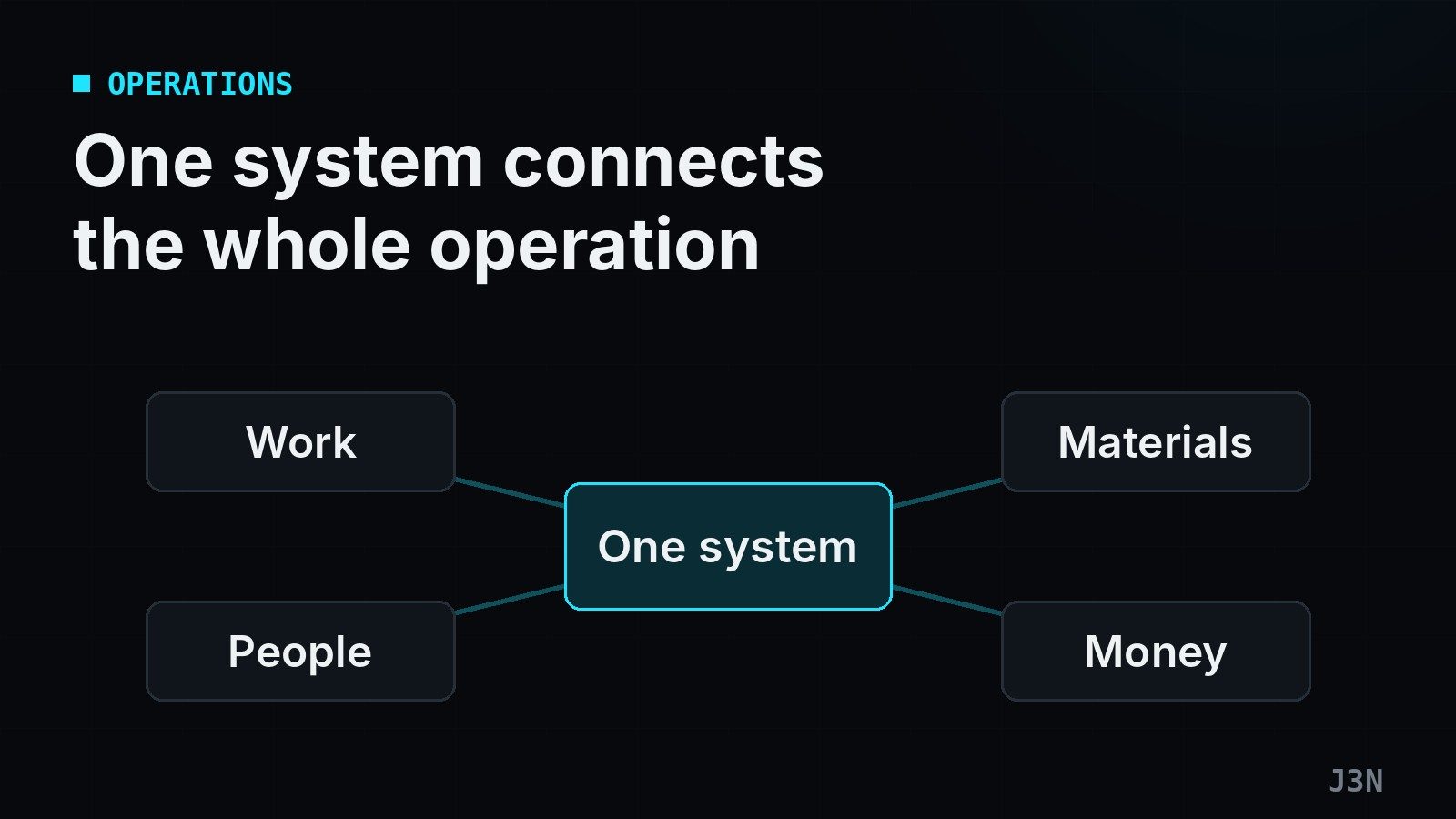
An OMS connects the work, the materials, the people and the money, so a business can see and control its operations in one place.
"Operations Management System" can sound like jargon. In practice, it is simple to describe: an OMS is the software that records and controls the daily work of a business.
The four things it connects
- The work. Orders and job cards, the stages each job moves through, and who is responsible at each stage.
- The materials. What is in stock, what each job consumes, and when something needs to be reordered.
- The people. Who is on shift, what they are assigned to, and how long the work takes.
- The money. Quotations, sales, and the real cost of each job in materials and labour.
Each of these can be tracked separately. The value of an OMS comes from connecting them. When a job card records the materials issued to it and the hours worked on it, the business can see what that job actually cost, not what it was estimated to cost.
What that makes possible
With one connected system, a manager can open a dashboard and see which jobs are running late, which materials are running low, and how the week's production compares with the last. A supervisor can move a job to the next stage from the workshop floor. Month-end reports are produced from records that already exist.
Built around the business, not the other way round
Off-the-shelf software can work well when a business fits its assumptions. Many workshops and operations do not: their stages, materials and costing are specific to them. A custom OMS is designed around that workflow, which is why it gets used rather than worked around.
From our work: in a fabrication workshop we built an operations system for, open job cards, jobs by stage and low-stock alerts sit on one dashboard, so a manager sees late work and missing materials in the same place.